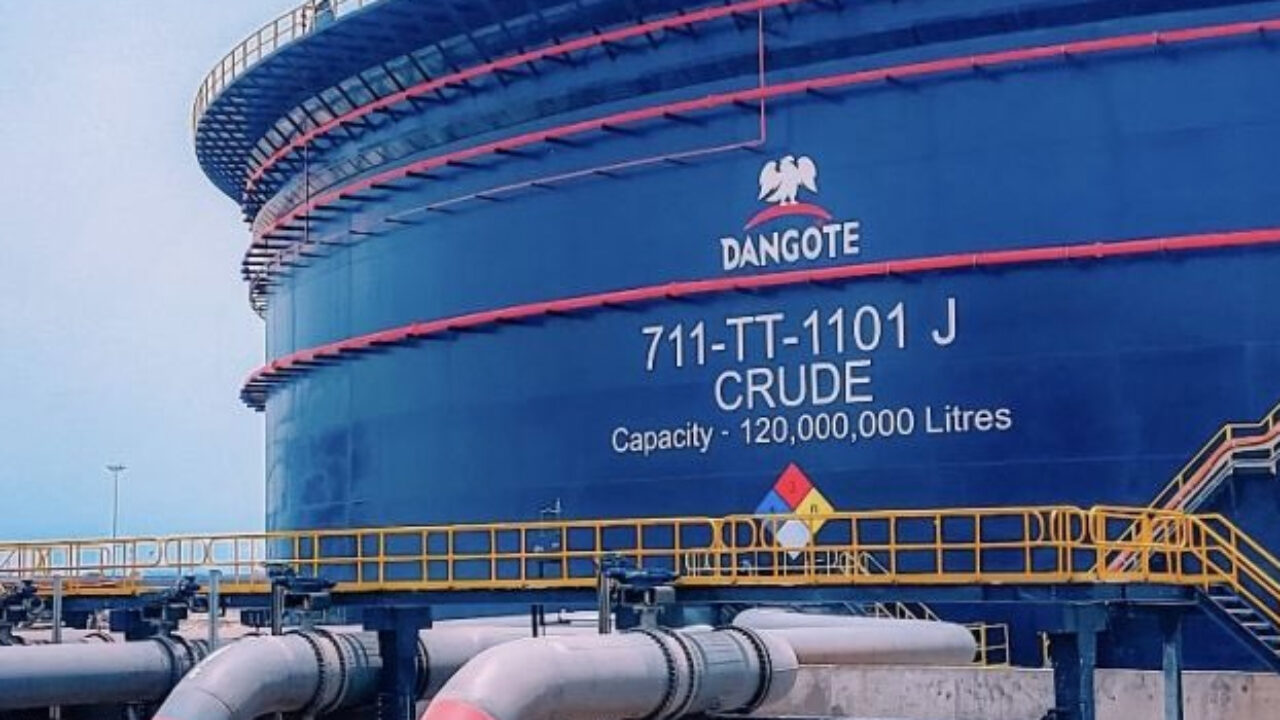
The Dangote Petroleum Refinery and Petrochemicals (DPRP) has locked in a $1bn underwriting program, adding a fresh layer of financial firepower to Africa’s most closely watched initial public offering as the countdown to a planned listing enters its final stretch.
The facility, structured jointly by Marob Strategies and Consulting DIFC Ltd, chaired by former Afreximbank president Professor Benedict Okey Oramah and Simon Tiemtoré’s Lilium Capital Group, is split into two tranches: a $600m private placement that has already been fully subscribed andfunded andd a $400m standby underwriting commitment earmarked to backstop the IPO itself.
Both tranches were underwritten through Pan-African Refinery Investment SPV, a Lilium Capital subsidiary, according to a Dangote Group statement issued on Tuesday.
The $1bn arrangement is not happening in isolation. It builds on a considerably larger pre-IPO fundraising drive: earlier this year Dangote disclosed that a private placement of refinery shares had drawn as much as $2 billion of investor demand ahead of the proposed listing, while more recent reporting puts the completed pre-IPO placement at roughly $2.5bn, marking the first time external capital has entered the Nigerian mega-complex, ahead of a planned public listing later this year.
Dangote’s balance sheet has also been reinforced on the debt side, with the African Export-Import Bank underwriting $2.5 billion of a $4 billion syndicated loan to the refinery.
Taken together, the layers of financing debt, private equity placements, and now the Marob/Lilium underwriting program are designed to de-risk what is shaping up to be a landmark African capital markets event.
Dangote Group has appointed Stanbic IBTC Capital, Vetiva Capital Management, and FirstCap to lead the offering on the Nigerian Exchange, and industry sources say the company is targeting a listing that could raise to $5bn, with a source telling CNBC Africa the group is aiming for an October listing window.
Separate reporting has floated an even more ambitious multi-exchange structure, with plans described as a multi-exchange IPO aimed at doubling the refinery’s capacity and quadrupling fertilizer production, potentially valuing the broader group at up to $40bn.
According to the advisers, distribution of the underwriting participation is now being coordinated across “Global Africa,” a term the parties use to capture sovereign wealth funds, governments, institutional investors and Caribbean diaspora capital alongside traditional African institutional pools.
The response, they say, has been strong, reflecting rising institutional appetite for large-scale African infrastructure assets capable of generating durable, long-term returns.
Dangote Group frames the transaction as more than a financing milestone. In Tuesday’s statement, Aliko Dangote said the deal reflects confidence in the refinery’s strategic role and “created a platform for broader participation by African and Caribbean sovereign wealth funds, governments and institutional investors across Global Africa.”
Advisers argue the programme could help catalyse intra-African capital flows and nudge the continent toward a more integrated capital market, a goal closely tied to the African Continental Free Trade Area’s broader economic integration agenda.
Professor Oramah, chairing Marob Strategies, called the deal proof that “African-led capital markets transactions” can deliver institutional-grade access to transformative continental assets, while Lilium Capital’s Tiemtoré positioned the mandate as part of his firm’s push to connect major African infrastructure opportunities with global and pan-African institutional capital, framing it as support for industrialisation and long-term economic growth on the continent.
The 650,000-barrels-per-day refinery has already reshaped Nigeria’s energy landscape since coming on stream, and its economic footprint is significant: the International Monetary Fund has estimated the complex could lift Nigeria’s non-oil GDP by 1.5 percent while boosting foreign exchange reserves by $5.5 billion, and the project is credited with creating more than 150,000 jobs directly and indirectly.
Nigeria’s state oil company, NNPC, has also disclosed it extended a $1bn crude-backed loan to help the refinery through earlier liquidity challenges, underscoring how deeply intertwined public and private capital have been in getting the project to this point.
With retail investor interest already reportedly running high, the media has reported strong early demand from a cross-section of Nigerian investors, from wealthy individuals to students and first-time market participants.
The success or failure of the IPO is widely seen as a test case for whether African bourses can absorb a listing of this scale without leaning heavily on foreign capital markets.
The $1bn underwriting programme, in that sense, functions as an insurance policy: a guarantee that even if broader public demand falls short, a coordinated bloc of African and diaspora institutional money stands ready to fill the gap.
No final listing date, offer price, or exchange split has yet been confirmed by Dangote Group. The company has previously indicated investors will be given the option to subscribe in either naira or dollars, a detail likely to matter greatly for the regional and diaspora investors this underwriting program is explicitly designed to court.
WHAT YOU SHOULD KNOW
Dangote has now built multiple layers of financial insurance: a fully funded $600m private placement plus a $400m standby underwriting commitment specifically to guarantee its record-breaking IPO succeeds regardless of how retail demand plays out.
By pre-securing institutional and sovereign wealth backing across Africa and the Caribbean before the public offer even opens, Dangote and its advisers have effectively de-risked what could be Africa’s largest-ever public listing, turning it from a gamble on market appetite into a near-certainty.