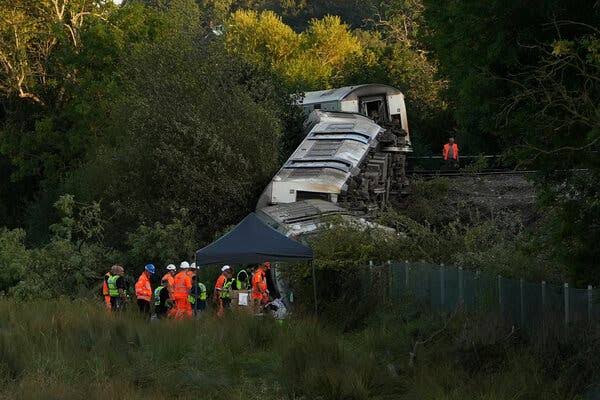
A routine Thursday afternoon commute turned to chaos on the outskirts of this East Sussex market town when a packed Southern Train left the tracks, overturning three of its eight carriages and triggering one of the region’s largest emergency responses in years.
The 14:24 Southern service from London Victoria to Eastbourne came off the rails shortly before 3:54 pm on Thursday, 13 August 2026, somewhere between Cooksbridge and Lewes.
The rear three of the train’s eight carriages toppled onto their sides beside the line, spilling passengers and belongings into the countryside embankment below.
Roughly 150 people were believed to have been aboard at the time. Passengers trapped in the mangled carriages described a terrifying few seconds as the train lost control.
One father travelling with his young daughter in the fourth carriage told the BBC he felt the train accelerate and begin to shudder before the emergency brakes engaged and the carriage was thrown violently off the rails the train skidding for a considerable distance before finally grinding to a halt.
When he turned around, he saw the rear of the train had torn open, dust and smoke pouring through the gap, with the fifth carriage lying on its side. He recalled passengers with cuts and head wounds in the aftermath, and said the scene inside the train felt chaotic for a period afterward.
A woman travelling alone gave a similarly harrowing account, describing being flung about as everything turned upside down, leaving her badly bruised. She estimated a wait of around 20 minutes before help reached the train, suggesting the crash site was difficult for crews to access a detail borne out by the scale of the response that followed.
The scale of the mobilisation reflected the severity of the incident. British Transport Police declared a major incident, and around 150 people who had been on board were evacuated safely.
More than twenty ambulances and three air ambulances attended the scene, alongside ten fire engines and a command support unit from East Sussex Fire and Rescue Service.
Passengers unable to free themselves immediately were assisted from the wreckage by fellow travellers and rescue crews using ladders, before being walked along a dusty track to a nearby housing estate. Those not requiring hospital care were taken to a community centre, where support agencies stepped in to help them.
By the evening, ambulance services confirmed the human toll: two people suffered serious rib injuries, while nine sustained less serious injuries, according to the latest figures though earlier police statements on the night had put the number of walking wounded closer to 20, with a total of 20 people taken to hospital in the immediate aftermath.
The discrepancy is typical of the fog that surrounds fast-moving major incidents, as initial estimates are gradually refined once every patient has been accounted for.
Speaking at a press conference that evening, British Transport Police Superintendent Dominique Ioannou said the force’s thoughts were with everyone affected. A major incident was also stood up at University Hospitals Sussex NHS Foundation Trust to manage the influx of casualties.
The precise cause of the derailment is still unconfirmed, but early indications point toward a fault in the track itself rather than the train. The train’s driver contacted the control centre at 3.51pm moments before the crash to report the developing problem, and it has since been reported that a track defect may have caused the incident, though this has not been officially confirmed.
Photographs taken at the scene showed a stretch of visibly buckled rail, though investigators have cautioned it remains unclear whether that damage caused the derailment or resulted from it.
The Rail Accident Investigation Branch, the body responsible for determining the cause of rail accidents in Great Britain, deployed a team of inspectors to begin gathering physical evidence at the site.
A full technical investigation is expected to take months, examining everything from track maintenance records and weather conditions to the train’s speed and braking systems in the moments before it left the rails.
The disruption to rail services in the area was immediate and severe. Southern suspended all services between Lewes and Brighton, Haywards Heath, Seaford and Eastbourne, issuing a blanket “do not travel” notice for the rest of the day while emergency crews worked the scene.
Transport Secretary Heidi Alexander said she was closely following developments and thanked emergency responders for their work, while the local MP for Lewes called it a serious and fast-moving situation.
Eastbourne’s MP said he had been told at least one of his constituents suffered rib injuries in the crash. A senior transport union official said that with so many people involved, the immediate focus had to remain on their safety and welfare.
For a town like Lewes better known for its historic castle, its bonfire societies and its position on a quiet stretch of the London-to-coast line Thursday’s derailment was a jolting reminder of how quickly an ordinary rail journey can turn into a major emergency.
As the wreckage is cleared and investigators comb the buckled track for answers, questions about the state of Britain’s rail infrastructure, and how a fault of this kind could go undetected, are likely to dominate the inquiry ahead.
WHAT YOU SHOULD KNOW
The Lewes derailment left dozens injured but, remarkably, no fatalities a testament to the emergency response and to passengers helping each other from the wreckage. The key factor to watch: early evidence points to a track defect, not driver or train error, as the likely cause.
Until RAIB completes its investigation, the real question isn’t just what happened on 13 August, but why the fault wasn’t caught before a train carrying 150 people ran over it.