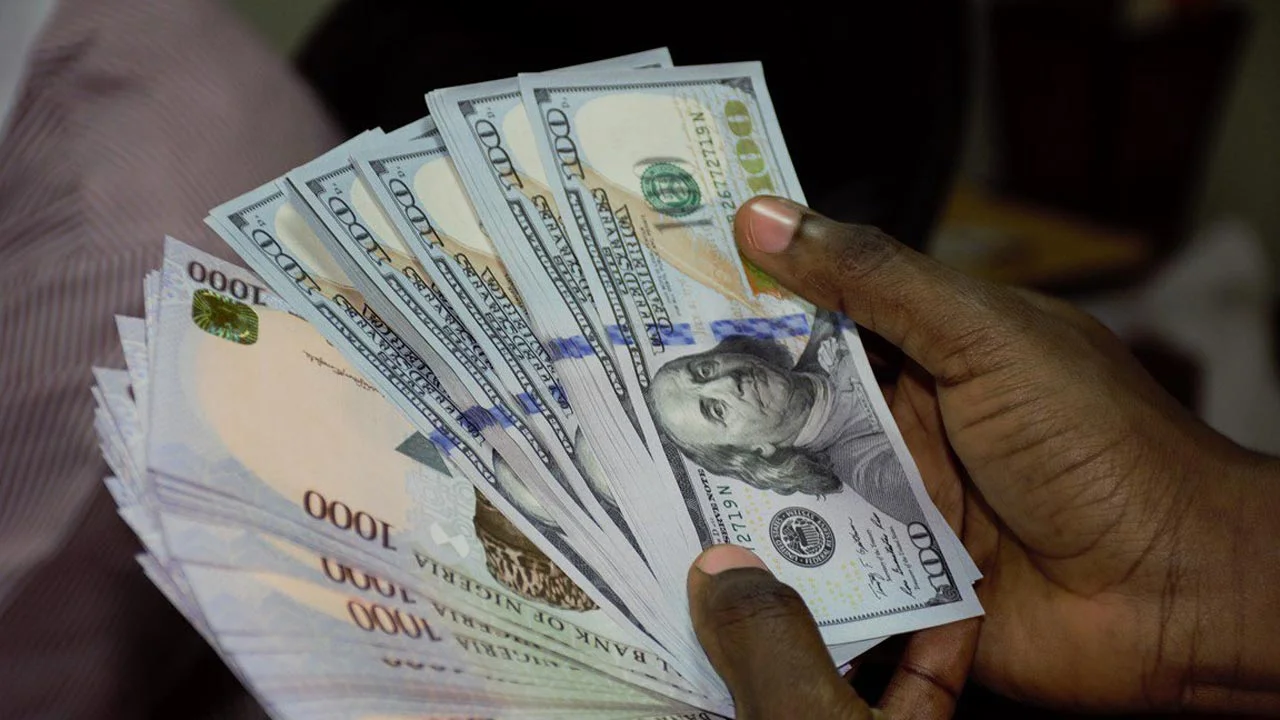
The naira closed out Wednesday’s trading session on familiar footing, exchanging at approximately ₦1,364 per US dollar on the official market, while the parallel market, Nigeria’s ever-watchful barometer of currency sentiment, recorded a selling rate of roughly ₦1,415 per US dollar.
For a currency that has spent much of the past three years lurching between crisis and correction, the numbers tell a quieter story: one of consolidation rather than convulsion.
Figures from the Central Bank of Nigeria placed the official Nigerian Foreign Exchange Market (NFEM) rate at around ₦1,364 per dollar, a level that has held with only minor variation across recent sessions.
Data tracked by Proshare showed the official rate oscillating in a tight band of roughly ₦1,362 to ₦1,370 in the days leading up to Wednesday, the kind of narrow trading range that, in Nigeria’s forex history, has often been the exception rather than the rule.
Away from the regulated market, the picture was similarly composed. Bureau de change operators and street dealers in Lagos quoted the dollar at about ₦1,405 on the buy side and ₦1,415 on the sell side, with some quotations drifting as low as ₦1,400 and others nudging toward ₦1,410 depending on the dealer and the size of the transaction.
What stands out to analysts is not the level of the rates themselves, but the gap between them. The spread between the official and parallel markets, long a proxy for how much Nigerians distrust the formal system or cannot access it, has narrowed considerably.
Gone, for now, are the days when black-market dollars traded at a premium wide enough to spark policy panic and accusations of round-tripping. In their place is a spread of roughly ₦50, modest by the standards of Nigeria’s recent forex turbulence.
Market participants attribute the stability to two intertwined factors: improved dollar liquidity and disciplined management of supply by the central bank.
The CBN’s continued interventions, whether through direct sales to authorized dealers or adjustments to market rules designed to channel demand through official channels, appear to be doing what years of piecemeal fixes struggled to achieve.
On the demand side, importers have so far exerted only moderate pressure on the currency, a restraint that traders say has helped keep the naira from tipping into the kind of volatility that characterized previous quarters.
Analysts cited that traders expect that composure to persist in the near term, buoyed by expectations that the CBN will keep leaning against excess demand for foreign currency rather than allowing it to build unchecked.
For ordinary Nigerians converting cash for travel, tuition, or trade, the arithmetic is straightforward but consequential:
- At the official rate of ₦1,364/$: $100 costs about ₦136,400; $1,000 costs about ₦1.364 million.
- At the parallel-market selling rate of ₦1,415/$: $100 costs about ₦141,500; $1,000 costs about ₦1.415 million.
The difference of roughly ₦5,100 on every $100 remains a meaningful “informal-market tax” for those without access to official channels, even if it is far smaller than the gaps that once defined the country’s dual exchange-rate era.
For a currency that has been through repeated devaluations, a unification of exchange-rate windows, and bouts of speculative attack, this current stretch of narrow-range trading is being read by market watchers as a sign of maturing, if still fragile, equilibrium.
Analysts caution that stability in Nigeria’s forex market has proven fleeting before and that any resurgence in import demand, a swing in oil earnings, or a shift in capital flows could quickly test the CBN’s ability to keep both markets this closely aligned.
For now, though, the numbers to watch remain simple: ₦1,364 to the dollar officially, ₦1,415 on the street a spread narrow enough, and a trend steady enough, to offer Nigerians a rare stretch of predictability in their daily currency calculations.
WHAT YOU SHOULD KNOW
The naira’s stability this week: ₦1,364/$ officially and ₦1,415/$ on the street comes down to one key factor: improved dollar liquidity from the CBN’s disciplined supply management. That’s what’s keeping the gap between both markets narrow and demand from tipping into pressure.
As long as the CBN keeps that supply steady, the naira should hold its current range, but this calm has broken before, so it’s worth watching rather than assuming it’s permanent.