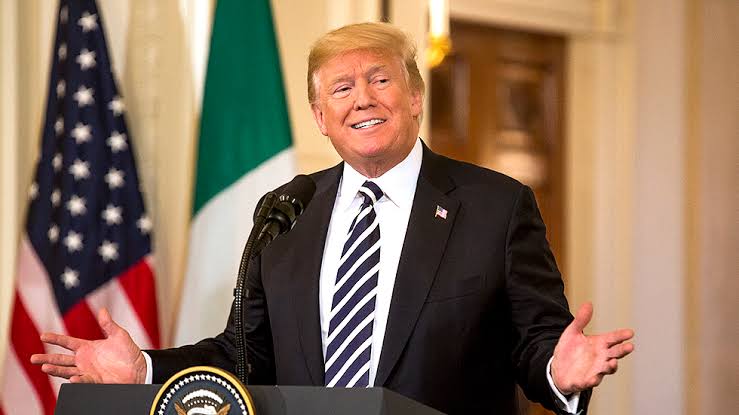
President Trump escalated his rhetoric on the Strait of Hormuz on Monday, telling Fox News’s “Fox & Friends” in a phone interview that the United States is effectively assuming control of the critical waterway from Iran and that other nations should start paying America for the privilege of keeping it open.
Asked about Iran’s efforts to assert control over the strait, Trump responded, “Well, we’re taking over the strait.” He went further later in the same interview, framing the move less as a military occupation and more as a paid protection service: “We’re going to keep the strait, and we’ll probably run it. We’ll become the guardian of the strait. Maybe we’ll call it the guardian angel of the strait. And we should be reimbursed for that.”
The reimbursement pitch had real teeth behind it. Trump said the U.S. is going to guard the strait and “get paid for guarding it a lot of money,” arguing that the wealthy nations benefiting from safe passage “are on our side, and we can’t be expected to do that for nothing.”
He did not detail how such a payment arrangement would actually work: no framework, no figures, no mechanism for collection.
The comments land against the backdrop of renewed U.S.-Iran hostilities. A memorandum of understanding the two countries signed last month had called for Iran to arrange safe passage and refrain from charging vessels transiting the strait for 60 days. But amid Iranian attacks on shipping, Trump declared last week that the ceasefire was over.
Iran, for its part, is not conceding the point. The body Iran uses to assert authority over the strait publicly declared the waterway closed on Monday, blaming U.S. military action, and said passage permits would only resume once “stability and calm” returned, directing inquiries to its own website and social media channels in the meantime.
The Pentagon disputes Iran’s claim to the strait entirely. U.S. Central Command described the Strait of Hormuz as a “vital maritime corridor for global trade” and stated flatly that Iran does not control it, adding that American forces remain “postured and prepared to ensure that freedom of navigation remains available to commercial shipping despite Iran’s continued unwarranted aggression.”
Trump’s framing raises questions that predate Monday’s remarks. When he first floated the idea of “taking over” the strait back in March, maritime law specialists were skeptical of the premise.
Shipping lawyer Alexander Freeman noted that the strait isn’t international waters under the UN Convention on the Law of the Sea and that without the consent of Iran and Oman, whose territorial waters cover it, any U.S. takeover would likely amount to an incursion on their sovereignty, regardless of the protective intent behind it.
Whether “taking over” means a formal U.S. naval policing operation, an informal escort service, or simply rhetorical posturing remains unclear. Trump’s own language has shifted between “running” the strait, becoming its “guardian angel,” and floating a straightforward toll system for the nations that rely on it.
What is clear is that the strait, which carries roughly a fifth of the world’s oil supply, is once again a flashpoint, and markets are watching closely for any sign of how or whether Washington intends to formalize its new role.
WHAT YOU SHOULD KNOW
Trump says the U.S. is taking over the Strait of Hormuz and wants other nations to pay America to guard it, but he’s offered no actual plan for how that would work, and legal experts say the U.S. has no jurisdiction to do this without Iran and Oman’s consent. Watch this as posturing amid a shaky ceasefire, not a done deal.