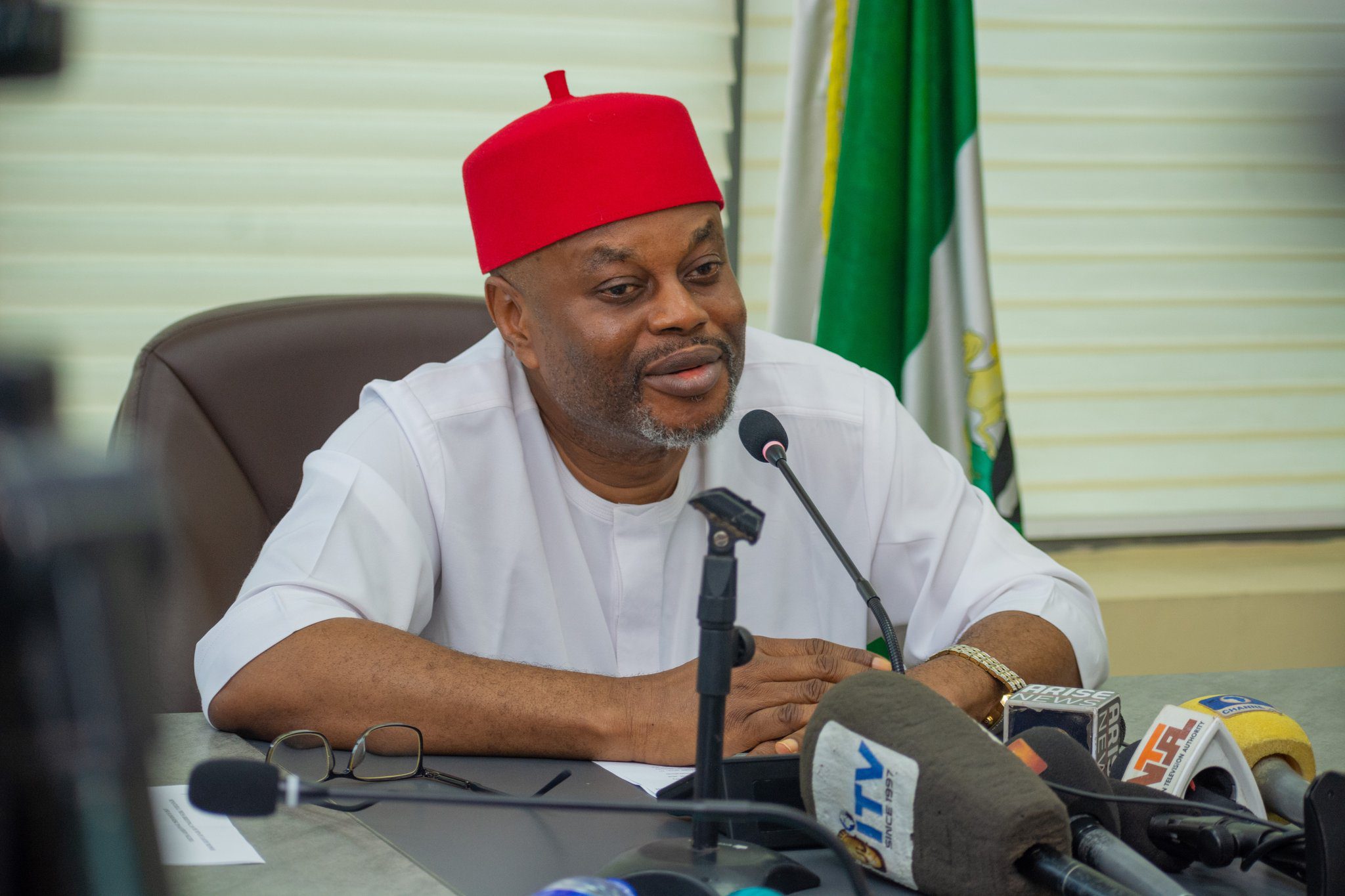
Former Minister of Innovation, Science, and Technology Uche Nnaji stood before the Federal High Court in Abuja on Monday and pleaded not guilty to a six-count charge accusing him of forging the academic credentials he presented during his 2023 ministerial screening.
The charges, filed by the Independent Corrupt Practices and Other Related Offences Commission (ICPC), center on two disputed documents: a degree certificate purportedly issued by the University of Nigeria, Nsukka (UNN), and a National Youth Service Corps (NYSC) discharge certificate.
Investigators allege both were fabricated and used to secure his appointment to the Federal Executive Council. Beyond the forgery counts, prosecutors have also levelled allegations that Nnaji drew roughly ₦29.5 million in salaries and other emoluments under false pretences, along with separate money laundering charges tied to those proceeds.
Presiding over the case, Justice Joyce Abdulmalik took the defendant’s plea before his lead counsel, Ogwu Onoja, a Senior Advocate of Nigeria, informed the court that a bail application had already been filed on his client’s behalf.
The prosecution, for its part, signaled it was ready for battle, announcing it had three witnesses lined up while notably declining to oppose bail, leaving the matter to the court’s discretion.
Justice Abdulmalik granted bail for ₦20 million, with conditions that read like a checklist designed to keep a former top government official firmly within reach of the law:
- One surety in the same sum of ₦20 million
- The surety must be a federal civil servant of at least Grade Level 15
- The surety must have lived at a fixed, verifiable address for a minimum of four years
- Proof required: a letter of employment and three months of salary slips
- The court has directed that Nnaji’s passport and other travel documents be surrendered
- Relevant authorities must verify the surety’s employment status before the bail is perfected
The case has now been adjourned to September 21, 2026, when trial proper is expected to begin.
Monday’s court appearance caps off a saga that began publicly unraveling weeks earlier. On July 1, the ICPC confirmed it had arrested Nnaji not in a quiet office raid but at the Nnamdi Azikiwe International Airport in Abuja, the moment he touched down in the country.
According to the Commission’s Head of Media and Public Communications, Okor Odey, the operation was carried out with the backing of the Department of State Services (DSS) and followed a bench warrant issued by the Federal High Court.
That warrant was not the ICPC’s first move. The Commission says it had tried the conventional route first, issuing a formal invitation to Nnaji dated May 15, 2026, and delivering it to his known addresses in both Abuja and Enugu, as well as to his email.
He did not respond or show up for questioning. That non-appearance, ICPC says, is what pushed the Commission to seek and obtain a court order on June 11, 2026, in Suit No: FHC/ABJ/CS/1160/2026, explicitly authorizing his arrest to compel his participation in the investigation.
The forgery allegations are not new. Nnaji had already stepped down from his ministerial post in October 2025, after reports surfaced questioning the authenticity of both his NYSC discharge certificate and his first degree.
He has consistently maintained that he graduated from UNN in 1975, but investigators noted the university itself was unable to verify his academic records, a gap that has since metastasized into a full criminal case.
At the time of his resignation, Nnaji was careful to frame his exit not as a concession of wrongdoing but as a gesture toward due process. “My decision to step aside is, therefore, a personal choice, not an admission of guilt, but rather a principled decision to respect the sanctity of due process,” he said then, adding that he believed “history will vindicate the just.”
He also struck a defiant note, casting the allegations as a politically engineered smear campaign. “An orchestrated and sustained campaign of falsehoods, politically motivated and malicious attacks have been waged against my person, integrity, and office,” he said, arguing the affair had become a distraction from the government’s “Renewed Hope Agenda.”
With bail conditions now in place and his travel documents surrendered to the court, Nnaji’s next real test comes in September, when the ICPC will be expected to make good on its promise to call its three witnesses and substantiate charges that strike at the heart of the credibility of Nigeria’s ministerial vetting process.
For now, the presumption of innocence stands, but the case has already reopened uncomfortable questions about how thoroughly the credentials of the country’s top officials are checked before they take office.
WHAT YOU SHOULD KNOW
Former Minister Uche Nnaji has pleaded not guilty to forging his UNN degree and NYSC certificates used to secure his 2023 ministerial appointment and now faces trial alongside charges of collecting ₦29.5 million under pretenses and money laundering.
Granted bail of ₦20 million with strict conditions, his case, set for trial on September 21, 2026, stands as a stark reminder of how easily unverified credentials can slip through Nigeria’s ministerial vetting process and why stronger scrutiny of public officials’ qualifications matters.