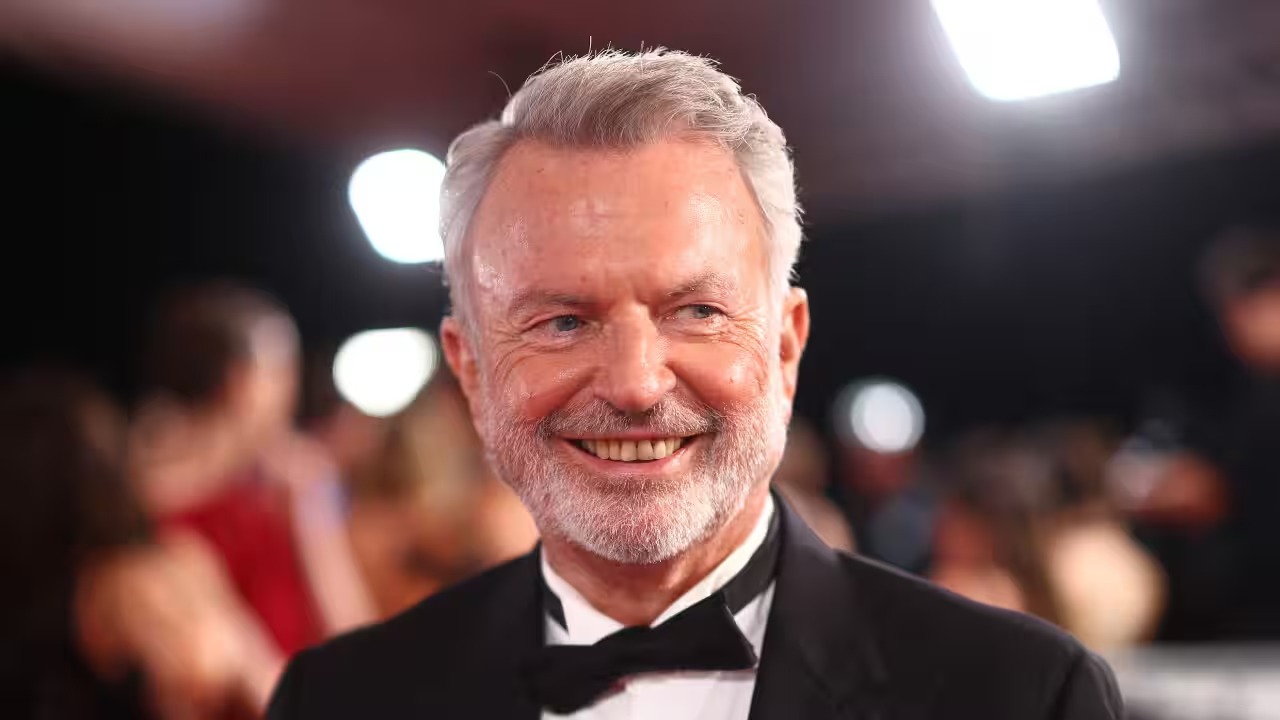
Sam Neill, the New Zealand actor whose warmth, wit, and quiet dignity made him one of the most enduring leading men to emerge from the wave of Australasian cinema in the late 1970s, has died. He was 78.
Neill’s family confirmed his death in a statement posted to his Instagram account, describing his passing as “sudden and unexpected” but noting he remained free of cancer at the time.
The statement read, “It is with immense sadness that the whānau of Sam Neill share the news of his passing on Monday, 13th July, in Sydney, Australia.” The family thanked the staff at St. Vincent’s Private Hospital for their care and asked for privacy as they process the loss.
The news landed with particular poignancy given Neill’s very public battle with illness. In 2023, Neill disclosed he had been diagnosed with angioimmunoblastic T-cell lymphoma, a rare type of non-Hodgkin lymphoma, and he underwent chemotherapy while writing his memoir.
He had announced in April that he was cancer-free, making his sudden death all the more unexpected. No cause of death has been specified.
Neill was born Nigel John Dermot Neill in Omagh, Northern Ireland, in 1947, before his family relocated to New Zealand’s South Island when he was a child. He later explained he adopted the nickname “Sam” partly to avoid being singled out at school.
He broke through internationally with Gillian Armstrong’s 1979 film “My Brilliant Career,” which also launched Judy Davis, and went on to become part of a generation of Australasian talent alongside Mel Gibson, Russell Crowe, Geoffrey Rush, Peter Weir, and Jane Campion, who carried the region’s film industry onto the world stage.
His range across five decades was striking: a Soviet submarine commander in “The Hunt for Red October,” the Antichrist in “Omen III: The Final Conflict,” a haunted astrophysicist gouging out his own eyes in “Event Horizon,” and Holly Hunter’s stern husband in Jane Campion’s Oscar-winning “The Piano.”
He earned Emmy nominations for the title role in the 1998 miniseries “Merlin” and for narrating “Wild New Zealand” and later found new audiences through “Peaky Blinders” and Taika Waititi’s “Hunt for the Wilderpeople.”
But it was as paleontologist Dr. Alan Grant in Steven Spielberg’s 1993 blockbuster “Jurassic Park” that Neill became a household name worldwide, a role he reprised across the franchise for three decades.
Away from film sets, Neill spent much of his time on his Central Otago farm and organic winery, Two Paddocks, which he founded in 1993. He was known for naming farm animals after friends and fellow celebrities and for self-deprecating humor that endeared him to fans well beyond his film work.
Tributes poured in from across the film world and government. New Zealand Prime Minister Christopher Luxon called him “one of the greats,” while fellow New Zealand actor Karl Urban described him as “a national treasure who gave so much to New Zealand and the world.”
WHAT YOU SHOULD KNOW
Sam Neill, the New Zealand actor beloved for his role as Dr. Alan Grant in the “Jurassic Park” franchise, died suddenly on July 13, 2026, in Sydney at age 78.
His death was unexpected and unrelated to the blood cancer he had battled for years; his family confirmed he was cancer-free when he passed.
Beyond “Jurassic Park,” Neill leaves behind a rich five-decade legacy spanning “The Piano,” “Peaky Blinders,” and dozens of other roles, remembered as much for his talent as for his humility and warmth.