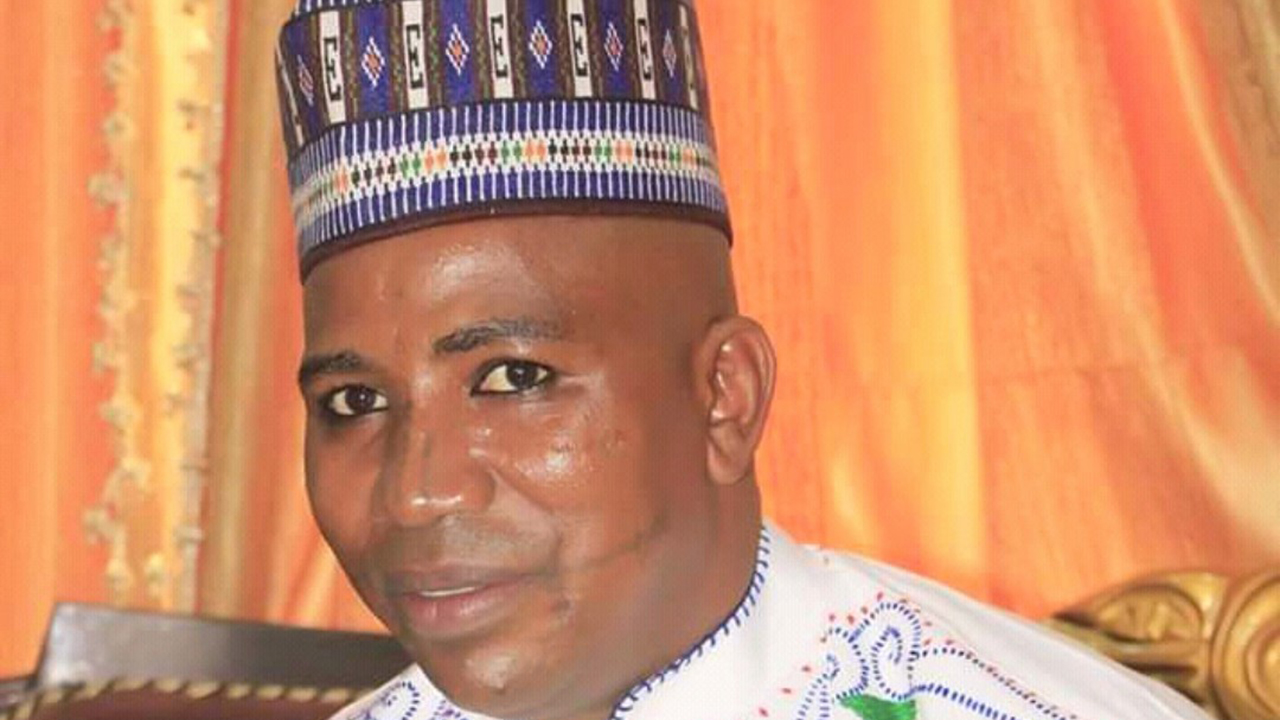
Senatorial aspirant Bello Bodejo has declared, from within the walls of an Economic and Financial Crimes Commission (EFCC) detention facility, that he remains an active and committed contestant for the Taraba Central Senatorial seat.
Bodejo, who was recently arrested by operatives of the Department of State Services (DSS) in Jalingo, the Taraba State capital, before being transferred to EFCC custody, made his defiant position known through his media aide, Mallam Umar, in a statement that has since sent shockwaves through the political landscape of the Taraba Central Senatorial District.
Speaking with the unmistakable tone of a man who refuses to be politically buried, Bodejo’s message, delivered by Umar, was pointed and unambiguous.
“He did not purchase the expression of interest and nomination forms to step down for anyone,” Umar declared on his principal’s behalf, in what many political observers are interpreting as a direct rebuff to unnamed political forces who may have anticipated that his arrest would effectively knock him out of the race.
The statement raises uncomfortable but inevitable questions: Was Bodejo’s arrest a politically motivated attempt to neutralize a competitive aspirant on the eve of critical party primaries? And if so, by whom?
Those questions remain unanswered for now, but they hang heavily over the political atmosphere in Taraba’s central senatorial zone.
The timing of Bodejo’s arrest is nothing short of dramatic. With the Peoples Democratic Party (PDP) primaries scheduled to be held on Monday across the five local government areas that make up the Taraba Central Senatorial District, Jalingo, Lau, Yorro, Zing, and Karim Lamido, the aspirant finds himself locked in an EFCC facility just days before his supporters are expected to cast their votes on his behalf.
Yet, through Umar, Bodejo has issued an urgent rallying call to his base.
“He is calling on his supporters and the good people of Taraba Central Senatorial District to come out in large numbers to vote for him during the primaries,” Umar said, in a statement that underscores not only Bodejo’s resilience but also the high-octane nature of political competition in the district.
The call to action from a detention cell is, by any standard, an extraordinary political moment, one that will likely energize his loyalists while deepening suspicions about the circumstances of his arrest.
Perhaps the most explosive revelation in Umar’s statement is this: as of the time of filing this report, the EFCC has not formally informed Bello Bodejo of the specific offense he is alleged to have committed.
This is a significant detail and a potentially damaging one for the prosecuting agency.
Nigeria’s Administration of Criminal Justice Act (ACJA) 2015 guarantees every suspect the right to be informed of the reasons for their arrest and detention without undue delay. If Bodejo has indeed been held without being told what he is accused of, legal experts say his counsel would have strong grounds to challenge the detention in court and seek his immediate release.
As of press time, the EFCC had yet to issue any public statement on the matter, and it remains unclear whether charges have been filed, whether Bodejo has been formally arraigned, or what evidence, if any, forms the basis of his detention.
This newspaper reached out to the EFCC’s Jalingo office for comment, but had not received a response as of the time of going to press.
Despite the legal cloud hanging over him, Bodejo did not shy away from making campaign promises. Through Umar, the embattled aspirant pledged that if given the mandate in the 2027 general elections, he would “work tirelessly to deliver meaningful development across the senatorial district” and would not disappoint the people who entrust him with their votes.
It is a forward-looking message that signals Bodejo’s intention to play the long game even if Monday’s primaries are conducted without his physical presence on the ground.
Bodejo’s situation is a sobering reflection of the increasingly treacherous terrain of Nigerian politics, where arrests, defections, court injunctions, and last-minute withdrawals have become as much a feature of the electoral process as campaigns and voting.
Whether his detention is a legitimate anti-corruption exercise or a calculated political ambush, only time and the courts will tell. But what is already clear is that Bello Bodejo has refused to go quietly.
For the voters of Taraba Central, the coming days will be watched with great interest. A primary election with a leading aspirant behind bars is not just a local story it is a mirror held up to the state of Nigerian democracy itself.
WHAT YOU SHOULD KNOW
Bello Bodejo’s arrest by the DSS and subsequent transfer to EFCC custody, just days before the Taraba Central Senatorial primaries, carries all the hallmarks of a politically motivated takedown.
The EFCC has not informed him of any offense, a glaring violation of his constitutional rights and a red flag that demands scrutiny.
Until the anti-graft agency provides a clear, lawful basis for his detention, the arrest looks less like justice and more like a political weapon.
Bodejo’s defiance from custody is secondary to the real story; the weaponization of state institutions to suppress political competition remains a clear and present danger to Nigeria’s democracy.