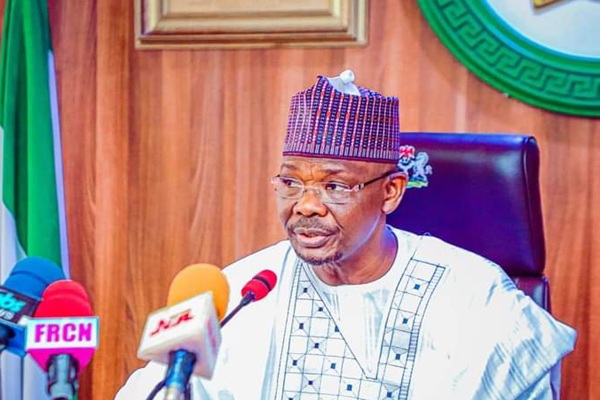
Nasarawa State Governor Abdullahi Sule on Friday publicly defended his decision to endorse a preferred successor ahead of the 2027 governorship election, while simultaneously announcing that the All Progressives Congress (APC) in the state would adopt direct primaries to determine its candidates.
Addressing residents from the state capital, Lafia, Governor Sule struck a tone that was at once assertive and conciliatory, a political tightrope walk that seasoned observers of Nigerian politics will immediately recognize as the delicate art of wielding influence while appearing to preserve democratic fairness.
Sule left little room for ambiguity. Invoking the dual shields of constitutional authority and democratic principle, the governor declared that his backing of an unnamed aspirant, described as possessing “the capacity, experience, and vision to consolidate the gains we have collectively made,” was not an act of political imposition but a legitimate exercise of leadership.
“As Governor of Nasarawa State and leader of our great party in the state, I have exercised my constitutional and democratic right to support and endorse an aspirant whom I believe possesses the capacity, experience, and vision to consolidate on the gains we have collectively made,” Sule said.
The phrasing is telling. By anchoring his endorsement in constitutional and democratic language, Sule appears to be preemptively neutralizing criticism from rival political camps who might frame his intervention as the heavy-handed maneuverings of an outgoing executive seeking to extend his influence beyond his tenure.
In Nigerian political parlance, this is what is commonly referred to as a governor “choosing his successor,” a practice as old as the country’s democratic experiment itself and one that has, in many states, triggered intra-party crises of considerable magnitude.
Notably, the governor declined to name the endorsed aspirant publicly, a strategic ambiguity that political analysts may read as either a bid to maintain suspense, consolidate backroom support before a public declaration, or avoid prematurely hardening opposition within the party ranks.
Perhaps the most consequential policy announcement of the broadcast was the governor’s declaration that the APC in Nasarawa State would conduct direct primaries ahead of the 2027 general elections, a decision he said was reached by key party stakeholders.
In the Nigerian electoral context, the choice between direct and indirect primaries is rarely a mere administrative decision. It is a deeply political one.
Direct primaries, in which all registered party members participate in selecting candidates, are widely regarded as more democratically inclusive and harder to manipulate through delegate-buying, a phenomenon that has long plagued indirect primary processes in the country.
By championing direct primaries, Sule is projecting the image of a party leadership committed to grassroots democracy. Yet political watchers will be quick to note that the announcement comes at a moment when the governor has already declared his preferred candidate, raising questions about the interplay between an incumbent’s endorsement power and the outcomes of a direct primary process.
“This does not foreclose the opportunities that exist in direct primary elections, which our party’s critical stakeholders have opted for,” Sule affirmed, adding: “Let me once more restate for the record that as a leader of the state, I will ensure a credible contest.”
The assurance, while welcome, will be tested in the weeks and months ahead as political temperatures in Nasarawa, like across much of Nigeria, begin their inevitable rise.
Beyond the political positioning, Governor Sule used the platform to deliver a pointed message of caution to all actors in the emerging electoral landscape. Directing his words at APC members, supporters of other political parties, youths, and community leaders alike, he appealed for calm and restraint as campaign-related activities gain momentum.
His warnings against hate speech, political intimidation, and the spread of disinformation are not merely rhetorical. Nigeria’s political history, including in North-Central states like Nasarawa, has been periodically scarred by electoral violence, and the 2027 cycle is already showing early signs of heightened tension across multiple states.
“No ambition is greater than the peace, unity, and progress of our dear State,” the governor declared, in what may well become a campaign-season refrain.
His appeal to young people, urging them not to allow themselves to be weaponized by political interests seeking to foment unrest, speaks to a persistent and troubling reality of Nigerian democracy: the recruitment of vulnerable youth as instruments of electoral violence, often by the very leaders who publicly decry such practices.
Sule also called on security agencies to conduct themselves with professionalism and neutrality throughout the electoral process, a directive that, while necessary, will ring hollow unless accompanied by institutional accountability mechanisms.
What Friday’s broadcast ultimately reveals is that the 2027 political contest in Nasarawa State is already well underway—not in the public squares and campaign grounds, but in the quieter corridors of power where endorsements are brokered, alliances are forged, and political destinies are shaped long before a single vote is cast.
Governor Sule, who has governed Nasarawa State since 2019 and overseen a period he characterizes as one of developmental progress, is clearly determined to shape what comes next. Whether his endorsed candidate will prevail in a direct primary against potentially strong opponents, and whether the process will indeed be as credible as the governor has pledged, remains to be seen.
What is certain is that Nasarawa, a state of considerable strategic importance in Nigeria’s north-central geopolitical zone, has entered its 2027 electoral season with all the familiar ingredients of Nigerian democratic politics: gubernatorial ambition, intra-party maneuvering, democratic rhetoric, and an undercurrent of tension that no amount of peace appeals can entirely mask.
WHAT YOU SHOULD KNOW
Nasarawa State Governor Abdullahi Sule has publicly endorsed a yet-to-be-named successor ahead of the 2027 elections, framing it as a constitutional right while announcing that the APC will use direct primaries to ensure an open contest.