A new crisis has hit the Peoples Democratic Party (PDP) after its Sokoto State chapter flatly rejected a dissolution order issued by the national headquarters.
The national headquarters of the PDP had, in a statement issued by its National Publicity Secretary, Jungudu Mohammed, announced the immediate dissolution of the Sokoto State executive committee, simultaneously unveiling a 15-member caretaker committee to assume control of party affairs in the state.
Hayatu Tafida was named as chairman of the interim body, with Ahmed S. Pawa designated as secretary, an arrangement the national leadership clearly intended to take effect without delay.
But that intention was met with swift and unequivocal resistance from Sokoto.
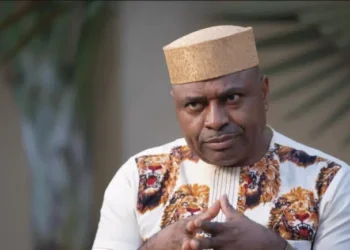
Bello Goronyo, the embattled Sokoto State PDP Chairman at the center of the storm, did not mince words in his response. Dismissing the dissolution order as constitutionally hollow and procedurally flawed, Goronyo declared that neither he nor his executive colleagues had any intention of vacating their offices, not for a statement, and certainly not for a caretaker committee installed without recourse to due process.
“When I saw the statement, I laughed,” Goronyo said, his tone a mixture of defiance and disbelief. “You cannot simply dissolve an elected executive. It cannot be done in that manner. We were duly elected into office, and only a court of law has the authority to remove us. Therefore, we remain the legitimate leaders of the PDP in Sokoto State.”
His position is not without legal grounding. Under the PDP constitution, as with most democratically structured party frameworks in Nigeria, executives who emerge through a legitimate electoral process at a congress are accorded a degree of tenure protection that cannot be summarily revoked by administrative fiat from the top.
For the national headquarters to dissolve such a committee, critics argue, there must be demonstrable cause, adherence to internal party due process, and, in most contested cases, judicial clearance.
Goronyo himself drew attention to the broader crisis engulfing the party’s national leadership, acknowledging that a succession dispute at that level is currently pending before the Supreme Court of Nigeria.
It is a crisis that has cleaved the party into rival camps, with competing power blocs each claiming legitimacy and, in many instances, seeking to consolidate their influence across state structures nationwide.
Yet Goronyo was careful to draw a firm distinction, insisting that whatever judgment the apex court ultimately delivers on the national leadership question does not retroactively invalidate or truncate the tenure of his duly constituted state executive.
That argument, if sustained, could render the caretaker committee an administrative fiction, a structure on paper with no practical authority on the ground in Sokoto.
For seasoned political observers, the stand-off is less surprising than it is symptomatic. The PDP, once the dominant political force in Nigeria and the party that governed at the federal level for sixteen uninterrupted years, has in recent times become increasingly defined by internal power struggles that have fragmented its national structure and weakened its capacity to mount a coherent opposition.
The Sokoto episode is only the latest in a long series of flashpoints across multiple states where national directives have collided with entrenched local interests.
With two parallel structures now laying claim to PDP authority in Sokoto, the Goronyo-led elected executive and the Tafida-led caretaker committee, the party faces the real prospect of paralysis in the state, particularly as political activities ahead of future electoral cycles begin to intensify.
As of the time of filing this report, neither the national headquarters nor the caretaker committee had issued any further public statement in response to Goronyo’s defiance.
What is clear, however, is that the battle for the soul of the PDP in Sokoto State is far from over, and if history within this party is any guide, the courts, not the party secretariat, may well have the final word.
WHAT YOU SHOULD KNOW
The PDP’s internal crisis has taken a new dimension in Sokoto State, where the elected state executive has flatly rejected a dissolution order from the national headquarters, standing firm on a simple but powerful legal argument that an elected body can only be removed by a court of law, not by administrative decree.
Until that battle is resolved, parallel power structures will continue to emerge across states, leaving the party increasingly ungovernable from within and increasingly unconvincing as a credible opposition force to the Nigerian public.