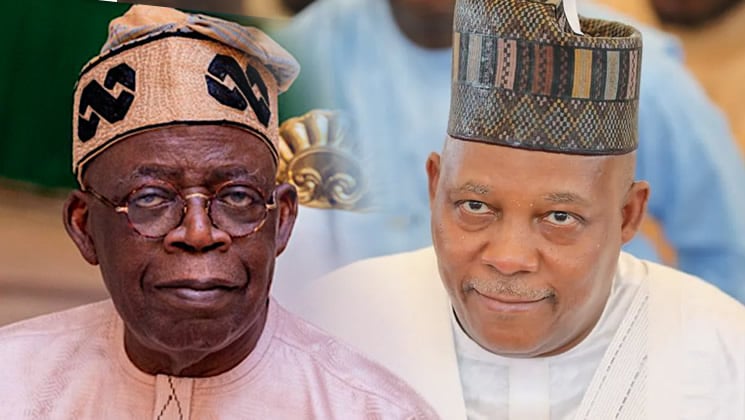
With more than a year to the next general election, quiet political calculations have already begun inside Nigeria’s ruling party.
Attention has now turned to one of the most sensitive issues in any presidential race: the choice of a running mate.
A recent claim by former Sports Minister Solomon Dalung that President Bola Tinubu may replace Vice President Kashim Shettima has reopened debates that many thought were settled after the 2023 election.
Although the All Progressives Congress has firmly denied the claim, the issue continues to attract attention because it touches on religion, regional balance, party loyalty, and Nigeria’s image abroad.
In Nigerian politics, such rumours rarely come without deeper fears and quiet conversations within powerful circles.
Why the Muslim–Muslim Ticket Refuses To Fade
The decision to field a Muslim–Muslim ticket in 2023 was one of the boldest and most controversial moves in recent political history.
Supporters argued that competence should matter more than religion, while critics warned that it could deepen division in a country already struggling with religious tension.
The ticket won the election, but it did not end the debate.
Many Christian leaders and groups continued to express discomfort, and some regions remained bitter about what they saw as exclusion from the highest offices of the land.
As 2027 approaches, party leaders must ask a difficult question: will the same formula still work? With public anger rising over economic hardship and insecurity, repeating a ticket that once caused strong emotions may now carry higher risks.
Dalung’s claim suggests that some inside the APC may believe the party needs a new balance to protect its chances.
Religion, Power Sharing, and Nigeria’s Fragile Unity
Religion plays a quiet but powerful role in Nigerian politics.
For decades, major parties have tried to balance Christian and Muslim candidates to reflect the country’s diversity and calm fears of domination.
Breaking this tradition in 2023 may have worked once, but doing it again could test the patience of many voters.
In areas where religion strongly shapes political loyalty, even a small shift in perception can affect millions of votes.
If Tinubu is thinking about 2027, he must weigh not only loyalty to his deputy but also the wider need to keep the country politically stable.
A change in running mate could be seen as an attempt to rebuild trust with Christian voters who felt ignored in the last election.
The Question Of Foreign Influence And Nigeria’s Image
One striking part of Dalung’s claim is the suggestion that international partners, especially the United States, may be uncomfortable with another Muslim–Muslim ticket.
Whether this pressure truly exists or not, Nigerian leaders care deeply about how the country is seen abroad.
Nigeria relies on foreign investment, security support, and diplomatic goodwill.
Leaders often worry that certain political choices could damage the country’s image or weaken important partnerships.
However, Nigerian elections are decided mainly by Nigerian voters.
No foreign government votes in Nigerian polling booths.
While global opinion may shape elite thinking, it cannot replace local political realities.
Still, the mere idea that foreign opinion might matter shows how closely Nigeria’s domestic politics is now linked to its international standing.
Can A Sitting Vice President Be Removed Without Cost?
Replacing a sitting vice president is one of the hardest political decisions any president can make.
Kashim Shettima is not only Tinubu’s deputy; he represents a powerful political base in the North-East and enjoys the support of many northern leaders who were key to Tinubu’s victory in 2023.
Dropping him could be seen as betrayal by allies who stood by Tinubu at a critical moment.
It could open old wounds inside the APC and create new factions just when the party needs unity.
There is also the question of loyalty and trust.
Removing a vice president without clear public conflict sends a message that no alliance is safe.
This could make other party leaders nervous and weaken Tinubu’s authority within his own camp.
So far, there is no public sign of tension between Tinubu and Shettima.
Official statements from both the presidency and the APC strongly reject any plan to change the ticket.
The Shadow Of Economic Hardship
Perhaps the most powerful factor shaping 2027 is not religion or foreign opinion, but the economy.
Nigerians are facing rising food prices, high transport costs, job losses, and growing insecurity.
Public anger is real, and opposition parties are watching closely.
If these problems continue, Tinubu may enter the next election with weaker public support than he enjoyed in 2023.
In such a climate, changing a running mate could be seen as a political strategy to refresh the ticket, send a new message, and attract voters who are losing faith in the government.
But this strategy is risky. Voters may see it as a sign of panic rather than strength.
LIt could also distract attention from the real issue, which is fixing the economy and improving daily life.
What Dalung’s Claim Reveals About APC’s Inner Fears
Even if Dalung’s claim turns out to be false, it reveals something important. It shows that there is anxiety within political circles about the future.
Parties usually begin to test ideas through rumours and trial balloons long before formal decisions are made.
Discussions about religion, balance, and foreign opinion suggest that APC leaders are already thinking deeply about how to survive a difficult election.
The denial from the party may be sincere, but politics often changes quickly as elections draw closer.
At this stage, there is no solid evidence that President Tinubu plans to replace Vice President Shettima.
Official voices insist the ticket remains intact, and political reality makes such a move very costly.
Still, Dalung’s claim has reopened serious questions about religion, power sharing, party unity, economic hardship, and Nigeria’s place in the world.
As 2027 approaches, Tinubu’s biggest challenge may not be choosing a new running mate, but rebuilding public trust, fixing the economy, and keeping his party united.
Only when those battles are clearer will Nigerians know whether changing a vice president is a real plan, or just another rumour in the long game of Nigerian politics.
Perfect — adding a “What You Should Know” section will make this analysis stronger and more professional.
Here is a clean, clear section you can insert near the end or after the middle of the article:
What You Should Know
First, there is no official move by President Bola Tinubu to replace Vice President Kashim Shettima.
The claim came only from former minister Solomon Dalung, and the APC has openly denied it.
Party leaders insist there is no discussion about changing the 2027 ticket.
Second, Nigerian law does not require a president to keep the same running mate for a second term.
A president is free to choose a new vice-presidential candidate if he decides to run again. However, such a decision is usually based on deep political talks and agreements within the party.
Third, vice-presidential changes are rare in Nigeria because they often cause anger and division. Most presidents prefer to keep their deputies to avoid offending powerful allies and regional leaders.
Fourth, Kashim Shettima plays an important political role for Tinubu in the North. He helped deliver key northern votes in 2023, and many governors, lawmakers, and party leaders in the region strongly support him.
Fifth, the 2027 election is still far away. Campaigns have not officially started, and party primaries have not been fixed. Many political stories at this stage are often used to test public reaction or send hidden messages within the party.
Finally, the biggest factor that will shape Tinubu’s decision may not be religion, but performance. If the economy improves and insecurity reduces, the pressure to change a running mate may disappear. But if hardship continues and public anger grows, new political strategies may begin to surface.