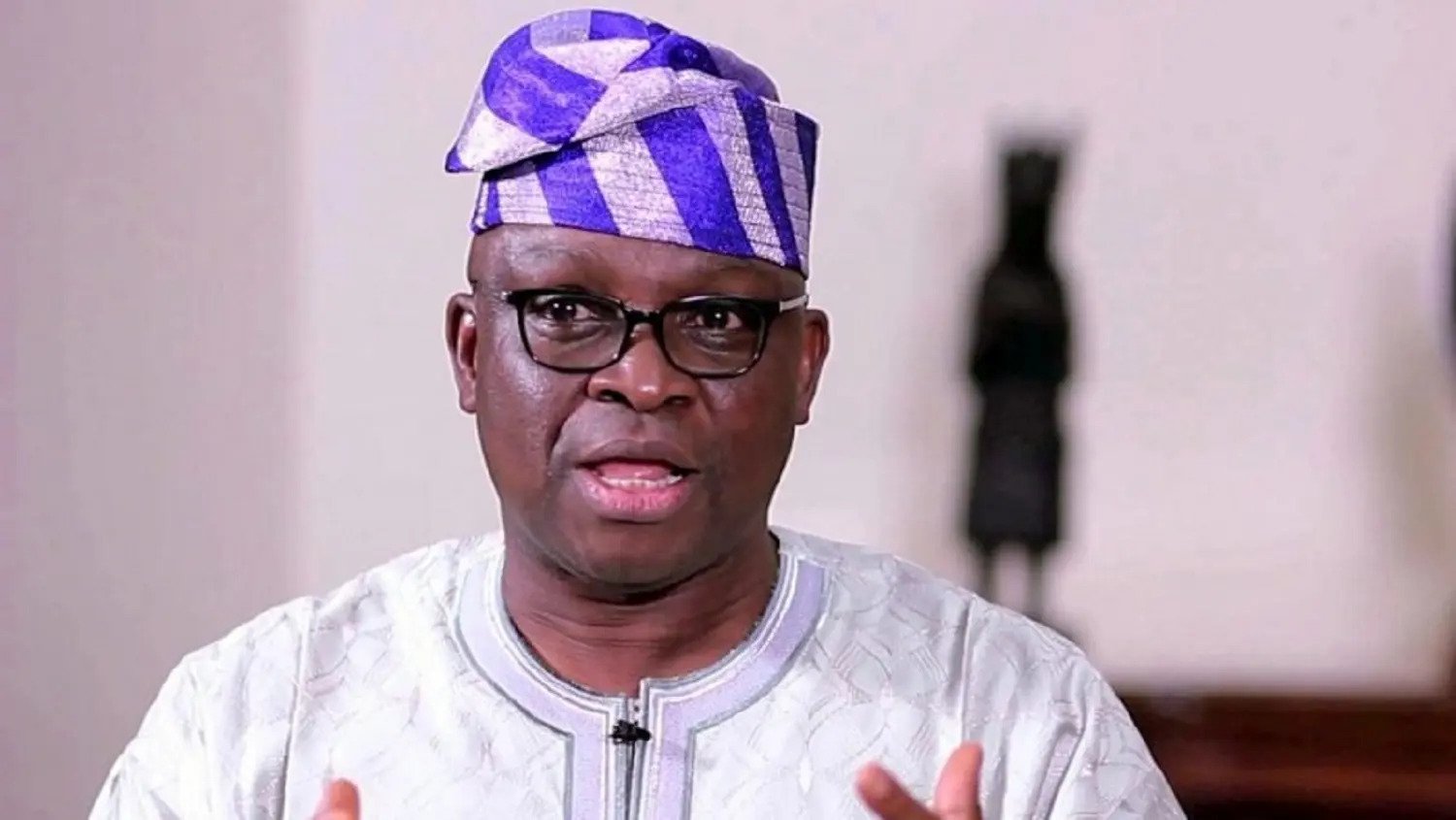
Ayodele Fayose, the ex-Governor of Ekiti State, has declared that the opposition Peoples Democratic Party (PDP) is now “dead,” attributing its collapse to persistent internal divisions and weak leadership.
Speaking during an interview on Channels Television’s Politics Today on Tuesday, Fayose lamented the steady disintegration of the once-dominant political party, describing its current state as “comatose.” He said the PDP’s decline had been long foreseen but ignored by those in leadership.
“A year ago, I said the PDP is in trouble, and if you don’t find that solution on time, the party will be dead, and the party is dead now,” Fayose stated. “Now, the party is dead. Again, I have to tell the hard truth: PDP is in trouble; the trouble has gone bad, and they are in comatose.”
He explained that the mass defection of influential figures from the PDP to rival parties was a sign of deep-rooted crisis and neglect. “I’ve told Nigerians the challenges confronting a party whose big heads and players have jumped out of the water. That clearly shows you the challenge of the PDP. Who is going to save Jerusalem when the people who are supposed to save Jerusalem have jumped out of the water?” Fayose asked.
Court Halts PDP Convention

The party’s troubles worsened earlier this week when Justice Peter Lifu of the Federal High Court in Abuja halted the PDP’s planned convention scheduled for November 15 and 16 in Ibadan, Oyo State.
The ruling followed a lawsuit filed by former Jigawa State Governor Sule Lamido, who alleged that he had been unlawfully denied the opportunity to purchase the nomination form for the national chairmanship position.
Justice Lifu stated that the PDP had failed to follow due process by not publishing a convention timetable as required by law. He warned that ignoring legal procedures could plunge the party into deeper crisis and ordered the convention’s suspension until all legal conditions were met.
Reacting to the development, Fayose criticised the Oyo State High Court for approving the convention despite the Federal High Court’s restraining order.
“Have you ever had in the judicial system that the state high court will hold a brief and say that they are representing the court of appeal, no matter how bad the case?” he asked.
“The judge in Oyo has now sat on an appeal of a Federal High Court. When has a state court become an appellate court?” Fayose questioned, accusing the Oyo High Court of exceeding its jurisdiction.
He warned that such judicial irregularities could worsen the PDP’s situation, adding, “If you open the doors, INEC will take all manner of judgements from state courts. The Oyo High Court has no jurisdiction.”
Fayose further alleged irregularities in the PDP’s national chairmanship process, insisting that the legal crisis was a reflection of the party’s broader leadership failure.
PDP in Turmoil
The PDP has been in turmoil for months, rocked by leadership battles, factional suspensions, and a wave of defections.
In 2025 alone, four serving governors—Sheriff Oborevwori of Delta, Umo Eno of Akwa Ibom, Douye Diri of Bayelsa, and Peter Mbah of Enugu—defected to the ruling All Progressives Congress (APC) ahead of the 2027 general elections.
The power tussle between acting National Chairman Umar Damagum and National Secretary Samuel Anyanwu has further deepened internal divisions, with both factions expelling each other’s loyalists.
The crisis reached another low point in July when former presidential candidate Atiku Abubakar resigned from the PDP, citing irreconcilable differences. He has since initiated coalition talks through the African Democratic Congress (ADC) to establish a new opposition alliance against the APC.
What You Should Know
Ayodele Fayose’s declaration of the PDP as “dead” highlights the deepening internal chaos within Nigeria’s main opposition party.
With multiple defections, leadership conflicts, and legal challenges undermining its stability, the PDP faces one of its toughest moments since losing federal power in 2015.
As new political coalitions emerge ahead of 2027, the party’s survival depends on whether it can restore unity and credibility in time.