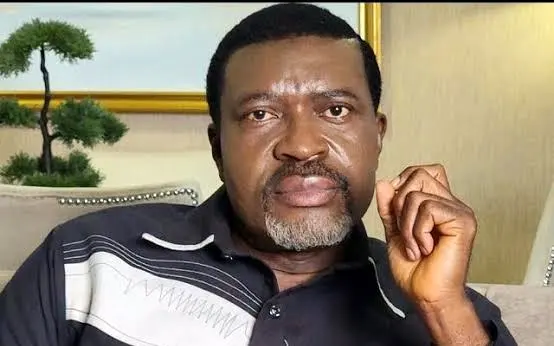
In a scathing critique of Nigeria’s entertainment industry, veteran Nollywood actor Kanayo O. Kanayo has launched a passionate campaign against what he describes as the dangerous resurgence of appearance-over-talent casting practices now plaguing YouTube-based film productions.
The 61-year-old actor, whose real name is Anayo Modestus Onyekwere, delivered his message with the weight of someone who has witnessed the industry’s evolution from its earliest days. Speaking from his Instagram platform to over a million followers, Kanayo didn’t mince words about the current state of digital filmmaking in Nigeria.
“Movie making is not about having a fine face; it’s about being a good actor, a good performer,” he declared in Monday’s video message, his voice carrying the frustration of an industry veteran watching history repeat itself.
Kanayo’s concerns stem from hard-earned experience. As one of the actors who helped birth modern Nollywood with his breakthrough performance in 1992’s “Living in Bondage,” he has a front-row seat to the industry’s cyclical challenges. His three-decade career has positioned him as both participant and chronicler of Nigerian cinema’s journey from its humble video film beginnings to its current digital renaissance.
The actor drew stark parallels between today’s YouTube casting practices and a dark period from Nollywood’s early years, approximately 25 years ago, when sponsors and promoters wielded destructive influence over casting decisions.
“Some sponsors woke up and started branding actors: ‘this one is not a good one; this one does not sell films.’ They killed the careers of those guys,” Kanayo recalled, his tone heavy with the memory of talents lost to market-driven decisions rather than merit-based assessments.
While he refrained from naming specific victims of that era—citing “the sanctity of this broadcast”—his implication was clear: the industry’s past mistakes are being repeated on digital platforms, with potentially devastating consequences for emerging talent.
Central to Kanayo’s critique is what he sees as the emergence of a new class of gatekeepers—popular YouTube faces who have created an exclusive ecosystem that mirrors the old studio system’s worst tendencies. These “acclaimed YouTube faces,” as he termed them, appear to have cornered the market on digital productions, creating an environment where new actors struggle to find opportunities.
The veteran actor painted a picture of an industry where a select few have become so indispensable that their schedules dictate content creation. “Some of these guys will tell you they are not free from September 2025 till August 2026,” he revealed, highlighting the absurdity of a system where content creation is held hostage by a handful of performers.
This bottleneck, according to Kanayo, raises fundamental questions about sustainability and creativity in Nigeria’s digital entertainment space. “How then do we sustain the content you watch? How do we create magic? How do we encourage new actors to come into the business?” he asked, articulating concerns that many industry observers have privately harbored.
Rather than merely complaining about the system, Kanayo announced a concrete response: a deliberate pivot toward working with new and underrecognized performers through his YouTube channel, Kanayo O. Kanayo TV. This represents more than just a career decision—it’s a philosophical statement about the values he believes should drive the industry.
“I have decided to take my destiny in my own hands as it pertains to my platform on YouTube,” he declared, positioning himself as both an alternative to and an antidote for the current system.
His approach challenges the fundamental assumption driving much of YouTube’s casting culture—that audience appeal trumps acting ability. “I don’t want any producer to call me for a job because I’m a selling face on any platform. Call me because I can deliver,” he emphasized, drawing a clear distinction between celebrity and competence.
Kanayo’s intervention comes at a critical moment for Nigerian digital entertainment. YouTube has emerged as a significant platform for Nollywood content, offering filmmakers direct access to audiences without traditional distribution bottlenecks. However, the platform’s algorithm-driven nature and emphasis on subscriber counts and views have created new forms of industry pressure that mirror old challenges.
The actor’s concerns about monopolization are particularly relevant given YouTube’s role in democratizing content creation. If the platform intended to level the playing field for filmmakers is instead creating new barriers to entry, it is defeating one of digital distribution’s primary advantages.
Despite his frustrations, Kanayo maintains the philosophical outlook that has sustained him through decades of industry turbulence. “I don’t know why when things come to Nigeria, there’s always a somersault, and this somersault is happening now on YouTube. But I want to employ my life’s philosophy to say, “This too shall pass,” he reflected.
This perspective—rooted in his experience of previous industry cycles—suggests both resignation and hope. Having witnessed Nollywood’s evolution through multiple phases, Kanayo appears confident that current trends, however damaging, are temporary.
As Kanayo prepares to implement his vision through Kanayo O. Kanayo TV, the industry will be watching to see whether his alternative model gains traction. His call for producers to “create stories with people who can deliver, who can act” represents a direct challenge to current casting orthodoxy.
The success or failure of his approach could signal whether Nigeria’s digital entertainment space is ready to prioritize craft over celebrity, or whether the cycle he describes will continue unchecked. For an industry that has always prided itself on storytelling over spectacle, Kanayo’s intervention represents both a return to foundational values and a test of the industry’s commitment to nurturing talent over exploiting popularity.
In an industry where yesterday’s innovations become today’s obstacles, Kanayo O. Kanayo’s latest campaign may prove to be either a nostalgic gesture or a necessary course correction. Time, as always in Nollywood’s rapidly evolving landscape, will tell.
WHAT YOU SHOULD KNOW
Veteran Nollywood actor Kanayo O. Kanayo is taking a stand against YouTube’s film industry for choosing actors based on looks rather than talent. The 61-year-old star, who helped build Nollywood from its early days, warns that digital platforms are repeating the same mistakes that destroyed promising careers 25 years ago when sponsors favored “marketable faces” over skilled performers.