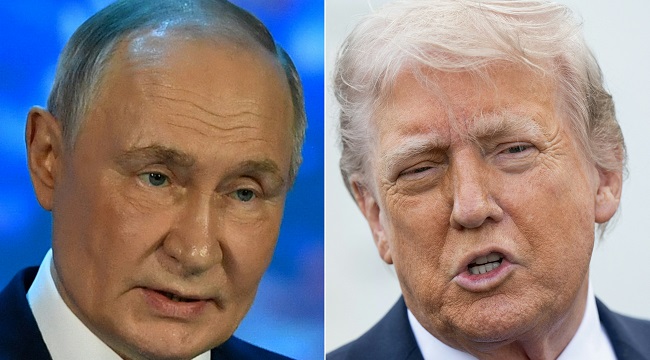
President Donald Trump has intensified his public spat with a senior Russian official, Dmitry Medvedev, by ordering the deployment of two nuclear submarines, a rare and stark escalation of a previously online confrontation over Ukraine and economic sanctions.
The move, announced on his Truth Social platform, signals a significant shift from digital rhetoric to a more serious and strategic military posture.
Citing “highly provocative statements,” Trump stated that he had directed two nuclear submarines to be stationed in strategic locations, though he did not clarify whether the submarines were nuclear-armed or merely nuclear-powered. The precise deployment sites were also left undisclosed, in line with U.S. military protocol regarding the secrecy of nuclear force positioning. “Words are very important, and can often lead to unintended consequences. I hope this will not be one of those instances,” the former president wrote in a post that raised global concerns.
Trump’s move follows a tense week of social media exchanges between him and Medvedev, Russia’s former president and now deputy chairman of its security council. Medvedev had previously criticized Trump on Telegram, invoking the Cold War-era “Dead Hand” system—an automated nuclear command structure—as a veiled warning. The jab was a response to Trump’s condemnation of Russia’s economy and his push for a new deadline for Moscow to end the war in Ukraine or face unspecified sanctions.
Amidst this growing hostility, Ukraine continues to suffer heavy bombardment from Russian forces. An AFP report confirmed that July saw a record number of drone strikes by Russia, with Thursday’s combined missile and drone attack on Kyiv killing 31 people, including five children. Bodies were still being retrieved from the ruins of a nine-storey residential building, with flowers placed by locals like 28-year-old mother Iryna Drozd, who said, “These are flowers because children died… Our children live across the street from here.”
Russian President Vladimir Putin, while expressing a desire for peace, reiterated his unchanging demands: Ukraine must relinquish some territories and abandon its pursuit of NATO membership. Despite mounting international pressure and a potential tightening of U.S. sanctions, Russia’s stance remains defiant, and its military campaign persists unabated.
Trump has not specified what Medvedev said that led to the submarine order, but the Russian official’s remarks included strong language against Trump’s sanctions threats. Medvedev warned that Trump was “playing the ultimatum game” and reminded him of Russia’s capabilities. Trump fired back on Truth Social, calling Medvedev “the failed former President of Russia” and cautioning him to “watch his words,” suggesting he was “entering very dangerous territory.”
Medvedev, once seen as a reform-minded leader during his presidency from 2008 to 2012, now plays a less influential but highly vocal role in Russia’s political landscape, often echoing the Kremlin’s aggressive nationalist messaging. Though no longer in a primary leadership position, his social media posts continue to stoke tensions with the West.
In a somber message from Kyiv, Ukrainian President Volodymyr Zelensky reaffirmed that Putin alone could bring the war to an end. Repeating Ukraine’s openness to direct talks, he stated that the United States had supported such dialogue. “What is needed is Russia’s readiness,” Zelensky wrote on X, underlining the ongoing impasse.
As the world watches the confrontation unfold, the exchange of threats between the U.S. and Russia now extends beyond economic and diplomatic fronts, inching closer to the realm of nuclear posturing—a sobering reminder of how geopolitical disputes can swiftly intensify.
What You Should Know
President Donald Trump’s decision to deploy two nuclear submarines in response to online sparring with Russian official Dmitry Medvedev marks a significant escalation in US-Russia tensions.
While the exact nature and location of the submarines remain classified, the move underscores the seriousness with which Trump views Russia’s provocative language amid the ongoing war in Ukraine.
This nuclear rhetoric emerges at a time when Ukrainian civilians are enduring heightened attacks from Russian forces. The situation highlights not only the fragility of global diplomacy but also the enduring threat of miscommunication or miscalculation between two nuclear powers.